AI Success: India Eager to Leverage US Tech Giants’ Innovations at Delhi Summit
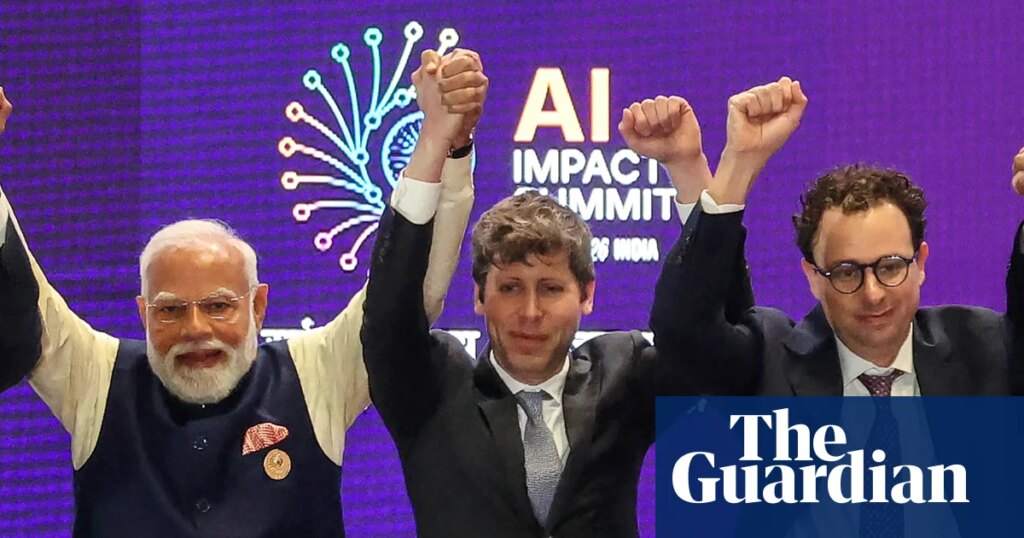
India is set to commemorate its 80th year of independence from British colonial rule in August 2027. Coinciding with this significant milestone, Sam Altman, co-founder of OpenAI, recently mentioned that we might be on the brink of “early versions of true superintelligence.” This prediction has sparked a compelling discussion during the AI Impact summit hosted by Prime Minister Narendra Modi in New Delhi, raising questions about India’s future in the AI landscape. Specifically, can India avoid losing its autonomy and reverting to a vassal state as it seeks to leverage AI to uplift its 1.4 billion citizens?
There is significant enthusiasm among Indian leaders to harness the immense potential of AI. Modi drew parallels during his address at the summit, likening this pivotal moment to historical turning points that have redefined civilization, not unlike the advent of fire or the dawn of electricity—a sentiment echoed by many attendees at the summit.
Visitors at the AI Impact summit in Delhi. Photograph: Anadolu/Getty
Modi’s vision for harnessing AI aligns closely with the ambitions of major US technology firms like OpenAI, Google, and Anthropic, which took center stage at the summit to unveil various partnerships aimed at making their AI technologies, such as ChatGPT and Gemini, widely accessible in India.
The previous Trump administration recognized the strategic significance of AI in competing against China and facilitated agreements among leading AI companies. A notable instance is the Pax Silica technology agreement, which aims to strengthen ties between India and the US, steering India away from reliance on Chinese technology.
During the agreement’s signing, Jacob Helberg, the US Under Secretary of State for Economic Affairs, emphasized the potential threat posed by China, warning against any inclinations to look elsewhere for AI assistance. His remarks hinted at a troubling incident from 2020 when a cyber-attack, suspected to be from China, left parts of Mumbai temporarily paralyzed.
India currently lacks the necessary infrastructure, such as semiconductors and extensive data centers, to independently advance in AI. Like other nations, it is faced with a binary choice between adopting US or Chinese AI models—each choice carrying substantial implications for its future governance and autonomy. The advent of superintelligent AI could not just reshape economic paradigms but could fundamentally redefine the structure of society.
Stuart Russell, an artificial intelligence professor at UC Berkeley, articulated concerns about the far-reaching repercussions of reaching a stage of artificial general intelligence (AGI). He predicted that AI could manage up to 80% of the global economy, revolutionizing industries from manufacturing to agriculture and services.
The US government signed the Pax Silica agreement, which binds India closer to US tech and away from Beijing. Photograph: Rajat Gupta/EPA
Imagine a scenario where an Indian village lacks the resources to establish a health center. In the future, AI might be able to design and assemble everything, using drones to deliver materials and robots to construct the facility. Within weeks, the community could gain access to essential healthcare services—a powerful example of technology’s transformative potential.
In such instances, technology becomes a core aspect of national development, but the assurance of sovereignty in this context is a complex matter that remains to be navigated. Those controlling AI gain unprecedented leverage over nations’ futures.
Anthropic’s CEO, Dario Amodei, indicated during the summit that AI could enable India to achieve an extraordinary 25% annual economic growth rate. If realized, this could elevate India’s per-capita GDP to levels comparable to Greece within just a decade—an enticing prospect for any leader.
India’s tech secretary, Shri Krishnan, articulated a clear understanding of the need for alliances with like-minded nations to avoid enslavement in the era of AI. The stakes are undeniably high.
Currently, it seems unlikely that India will turn to China for AI solutions due to existing tensions and the rarity of Chinese corporate presence at the summit. This also raises the question of whether India will flourish under US AI partnerships. Representatives from Silicon Valley have framed their engagement with India not as a client-vendor relationship but as a strategic partnership aimed at mutual growth.
US officials highlighted an alliance forged by historical struggles, emphasizing their shared democratic values and a commitment to building a prosperous future together. This sentiment, however, raises questions about potential digital colonialism.
When asked if India risks being controlled by the US’s technological prowess, Michael Kratsios, former science and technology adviser to Donald Trump, expressed confidence that countries using the American AI infrastructure would possess the most secure and independently controlled systems available.
A visitor takes part in a virtual reality demonstration at the summit. Photograph: Anadolu/Getty
Contrastingly, Russell warned of a potential downside; he speculated that American tech companies might aim to create a generation reliant on AI for basic tasks, which could lead to a population incapable of independent thought or function. The implications for India’s educational and social landscape could be profound.
Though India is focusing on ramping up investments in data centers and semiconductor capabilities, realizing an autonomous AI infrastructure will take considerable time. Altman pointedly remarked at the summit that aspiring Indian entrepreneurs must face the severe challenges of competing with established players in AI development, essentially urging them not to give up.
Narendra Modi with Emmanuel Macron in the audience at the AI Impact summit. Photograph: Stéphane Lemouton/Sipa/Shutterstock
Ultimately, India has the opportunity to push US tech companies to customize their AI technologies to suit the nation’s diverse languages and cultures while ensuring robust regulatory frameworks are established. The stakes are incredibly high, as underscored by Joanna Shields, a former Facebook executive and UK minister for internet safety. She cautioned against developing a global monoculture dominated by a few AI models, which could threaten the rich tapestry of cultural diversity essential to humanity.
Interested in growing your brand with smarter solutions? Get in touch with Auctera today.

Jessica
https://www.linkedin.com/company/aucteraAffiliate Content Writer