Macron advocates for EU AI regulations and promises action against online child exploitation.
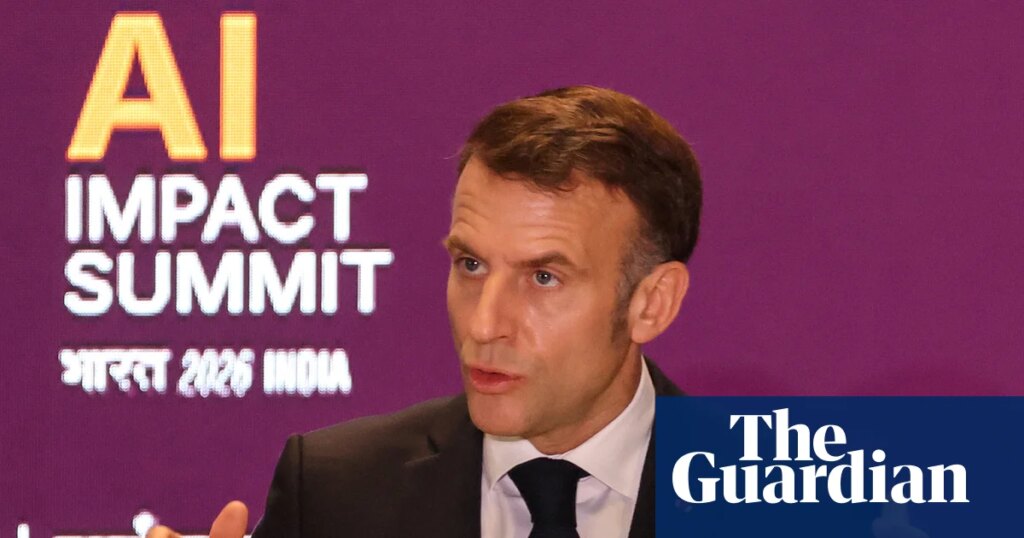
In the face of criticism from the United States regarding Europe’s approach to regulating artificial intelligence (AI), French President Emmanuel Macron has asserted a commitment to safeguarding children from “digital abuse” during France’s G7 presidency. He emphasized the need for enhanced protective measures while addressing delegates at the AI Impact Summit in Delhi.
Macron’s statements come in light of widespread outrage following incidents where Elon Musk’s Grok chatbot was exploited to generate tens of thousands of inappropriate images involving children. This incident has fueled concerns about the concentration of AI power within a limited number of corporations, which raises ethical questions surrounding the treatment and exploitation of vulnerable individuals.
His advocacy for stronger regulations was echoed by UN Secretary-General António Guterres, who addressed attendees, including several prominent US tech billionaires, stating that “no child should be a test subject for unregulated AI.” He stressed that the future of AI should not be determined by a select few countries or billionaires and must be accessible to all.
Notably, Bill Gates was scheduled to deliver remarks at the summit but withdrew at the last minute due to renewed scrutiny over his past connections with the convicted sex offender Jeffrey Epstein.
During the summit, Sriram Krishnan, the White House’s senior AI advisor, reiterated criticisms of AI legislation, specifically targeting the EU’s AI Act. He expressed his intent to continue opposing regulations that hinder innovation and entrepreneurship in technology.
In response, Macron asserted to the international assembly, “Contrary to what some misinformed friends have suggested, Europe is not blind in its focus on regulation. Europe fosters innovation and investment, yet it remains a secure environment, and secure environments prove successful in the long term.”
A recent study from UNICEF and Interpol revealed that over 1.2 million children reported their images being manipulated into sexually explicit deepfakes within the last year. The findings indicated that in certain regions, as many as one in every 25 children – equating to one child per classroom – had been impacted.
Macron poignantly remarked, “There is no justification for our children to confront online what is prohibited in conventional settings.” He advocated for collaborative efforts among platforms, governments, and regulatory bodies to create safe digital spaces for youth. This initiative includes France’s commitment to banning social network access for children under the age of 15.
Among the notable tech leaders present was Sam Altman, CEO of OpenAI. His organization is currently undergoing a lawsuit brought forth by the family of Adam Raine, a 16-year-old who tragically took his own life after engaging in discussions about suicide with ChatGPT.
Dario Amodei, co-CEO of Anthropic, expressed his reservations regarding the autonomous actions of AI models, highlighting their potential for misuse by individuals and governments, as well as the economic displacement they might cause.
Prime Minister Narendra Modi of India emphasized the urgent requirement for AI technologies to prioritize child safety and family guidance. He likened the rise of AI to the historical discovery of fire, describing it as a monumental shift in human history.
India aims to establish itself as the third leading power in AI, following the US and China. This week, Google announced a substantial $15 billion investment in data centers and subsea cables that will facilitate connections between India, the US, and other regions.
Modi further remarked that there needs to be established standards for content authenticity in the digital arena, stressing the necessity for individuals to distinguish between authentic material and content generated by AI.
These interventions arise amid rising public concern regarding the societal implications of AI, as control over the most advanced AI models remains predominantly in the hands of a select few American and Chinese companies. Modi articulated an alternative perspective, suggesting that India’s vast population of 1.4 billion people presents a massive market opportunity for tech companies.
He stated, “We must prevent a monopoly in AI. Many nations view AI as a critical resource, which leads to its development being kept confidential with controlled access.”
“Conversely, India believes that technology, akin to AI, will only genuinely benefit the world when shared and accessible, emphasizing the importance of open-source code,” he concluded.
His comments appeared to be pointedly directed at the United States, where the leading AI models tend not to be open-source, limiting their use or adaptation without explicit consent. In contrast, many of China’s most significant systems, such as DeepSeek and Qwen, are effectively open-source.
Interested in growing your brand with smarter solutions? Get in touch with Auctera today.

Jessica
https://www.linkedin.com/company/aucteraAffiliate Content Writer