China’s Dancing Robots: What are the Reasons for Concern?
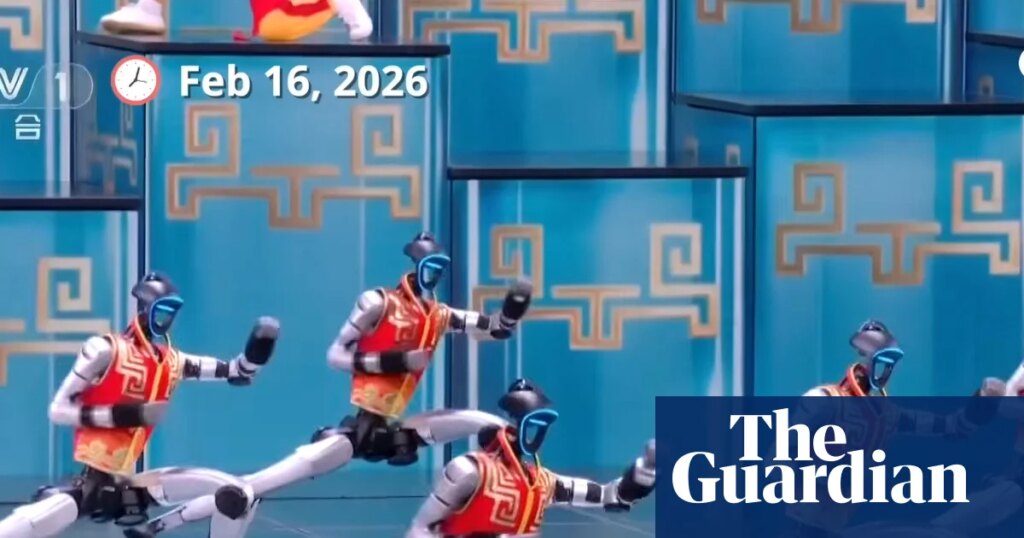
On Monday, the spotlight fell on dancing humanoid robots during the much-anticipated annual Spring Festival Gala, broadcast by the China Media Group. This event is known as China’s most-watched official television broadcast. The robots showcased their impressive skills, performing dynamic lunges, backflips that ended with graceful knee landings, and synchronizing spins and jumps without a single mishap.
The spectacle was nothing short of remarkable, leading viewers to speculate: if robots are capable of dancing and executing martial arts routines, what other feats can they accomplish?
Opinions from experts in the field are mixed. Some argue that the robots still have significant limitations and suggest that the performance should be interpreted as a form of state propaganda.
The robots, developed by various Chinese robotics firms, executed a series of intricate maneuvers, including kung fu demonstrations, comedy skits, and coordinated dance routines alongside human performers.
Clips circulated rapidly online, sparking comparisons to last year’s lunar new year broadcast, which featured robots performing simpler, less complex movements.
Kyle Chan, a technology development expert at the Brookings Institution in Washington DC, commented on how Beijing utilizes these public displays of robotics to “dazzle both domestic and international audiences, showcasing China’s technological prowess.”
“Unlike traditional AI models or industrial machines, humanoid robots provide visually appealing examples of China’s technological leadership that are accessible to the general public,” Chan noted.
He also pointed to the escalating competition in the tech sector between China and the United States, stating, “While both nations are closely matched in AI advancements, humanoid robotics stands out as an area where China can assert its superiority over the US, particularly in terms of large-scale production.”
Georg Stieler, who leads robotics and automation at the global consulting firm Stieler Technology and Marketing, highlighted the significance of China’s prime-time gala. “What sets this event apart from similar shows worldwide is the straightforward link between industrial policy and prime-time entertainment,” Stieler mentioned in a recent statement.
Comparing this year’s exhibition to last year’s, which he described as primarily unified in choreography with limited movements like walking and kicking, Stieler remarked on the progress made in robotic technology. He emphasized, “A key indicator of advancement is the ability to orchestrate large groups of nearly identical humanoid robots moving in sync, demonstrating stable gaits and uniform joint behavior.”
Nevertheless, Stieler cautioned, “The abilities displayed on stage do not necessarily reflect real-world industrial capability.” He noted that the robots’ performances stemmed from repetitive training tailored for a specific routine—altering direction or executing a new action is still beyond their capabilities.
“The dance routines rely on limited environmental awareness and mainly involve imitation learning supplemented with a controller to maintain balance. This has little relevance for deployment in variable conditions, which is crucial for any industrial application. Furthermore, the pace of advancement in dexterity lags behind that of mobility,” he explained.
The introduction of China’s latest generation of robots highlights the country’s overarching technological ambitions.
By the end of 2024, China is projected to have registered 451,700 smart robotics firms, amassing a staggering total capital of 6.44 trillion yuan (roughly $932.16 billion), based on government statistics. Significant initiatives like Made in China 2025 and the 14th Five-Year Plan have emphasized robotics and AI as priority areas for Beijing.
Morgan Stanley forecasts that sales of humanoid robots in China will more than double, reaching 28,000 units by 2026. Furthermore, Elon Musk has indicated that he views Chinese firms as his primary competitors as he shifts Tesla’s focus toward embodied AI and its flagship humanoid, Optimus. “Many underestimate China from outside, but their capabilities are formidable,” Musk remarked last month.
Marina Zhang, a technology professor at the University of Technology Sydney, stated that such a prominent display likely signifies a new chapter in China’s manufacturing evolution. She believes that “the integration of robotics is becoming a crucial element in transitioning from low-cost production to advanced, intelligent manufacturing.”
With contributions from Reuters
Interested in growing your brand with smarter solutions? Get in touch with Auctera today.

Jessica
https://www.linkedin.com/company/aucteraAffiliate Content Writer