Tech Titans Redefine Humanity as Traditional Billionaires Appear Outdated
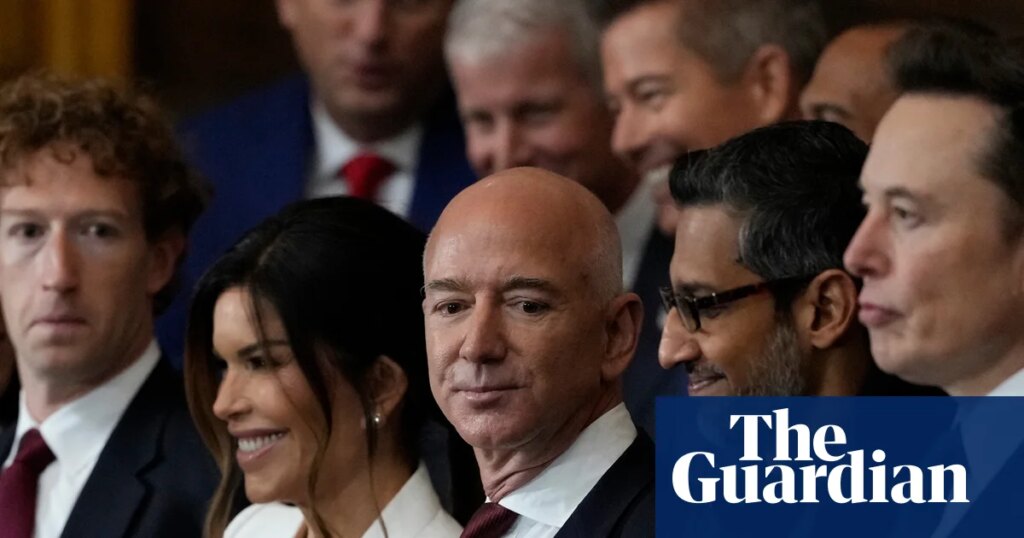
In 1992, when Bill Gates ascended to the heights of wealth and influence, he became the first modern IT mogul to achieve this significant milestone. The world at that time was starkly different. Gates found himself among the top 10 on Forbes magazine’s billionaires list alongside a global ensemble of wealthy individuals, including Japanese, German, Canadian, South Korean, and Swedish billionaires, many of whom benefited from family fortunes. The industries represented were diverse—retail, media, property management, packaging, investment, and industrial conglomerates. Collectively, their wealth neared an astonishing $100 billion, constituting roughly 0.4% of the US GDP in that year.
Fast forward to 2025, and the landscape of billionaire oligarchy has undergone a radical transformation. Among the top 10 wealth holders were only a few traditional billionaires, notably Bernard Arnault of the French luxury giant LVMH, Amancio Ortega from Spain’s clothing sector, and Warren Buffett, the well-known US investor. The remaining billionaires predominantly amassed their fortunes in the tech sector: Elon Musk, Jeff Bezos, Mark Zuckerberg, Larry Ellison, Steve Ballmer, and Google’s Sergey Brin and Larry Page. Collectively, this group boasted a staggering $16 trillion in wealth, equating to about 8% of the US GDP.
This remarkable shift underscores how swiftly new technologies have reshaped the global economy in the past quarter-century. It also highlights a significant concern regarding who enjoys the benefits of this growth, leading to a pressing question: what implications arise when a small group of tech oligarchs control the paths of technological evolution while occupying the peaks of wealth and influence?
As we consider the ramifications, it’s vital to explore whether pursuing human, or even superhuman-level, artificial general intelligence is a worthy ambition. Do we fully grasp what such a pursuit entails? What amount of investment and energy should we allocate to achieve this goal? Furthermore, which business frameworks will be sustainable in this future? Will AI potentially render human labor obsolete? Could a subsequent productivity boom lead to the availability of goods and services at no cost? What systems of wealth redistribution must be established to prepare for a future that might not include human participation?
These inquiries are consequential, yet they appear unlikely to be resolved through communal discourse or democratic processes. Instead, it seems that the decision-making power rests with the elite group topping Forbes’ 2025 ranking. This includes prominent figures like Anthropic’s Dario Amodei, Open AI’s Sam Altman, and tech financier Peter Thiel, among others. Collectively, they are positioned to influence the trajectory of artificial intelligence and, consequently, the future direction of humanity.
The issue extends beyond their wealth, as these billionaires often remain disconnected from the everyday realities faced by the average person. They tend to possess a worldview centered on the belief that technology provides the optimal solutions for all of humanity’s challenges—regardless of whether these challenges are social, political, economic, environmental, or otherwise. Their envisioned AI-driven future tends to overlook the complexities and mundane concerns of those living in the present day, discounted by their preference for swift technological advancements over slow, complicated democratic governance, which could hinder their envisioned utopia.
Interestingly, these oligarchs don’t necessarily fit neatly within either end of the political spectrum. Their aspirations often diverge from mainstream political debates. However, their allocation of resources, including nearly $200 million allocated thus far to hinder state-level AI regulations, reveals a crucial goal: to liberate artificial intelligence and facilitate the next chapter of humanity’s cosmic progression, which may not necessarily include current humans in their existing forms.
The ambitions of the tech oligarchs are not particularly concealed. Larry Page has posited that digital existence is a “natural and desirable next step” in the evolution of humanity. He asserts, “If we allow digital minds to flourish rather than attempting to restrain or subjugate them, the outcome will likely be beneficial.” Moreover, Altman has claimed that humanity “will be the first species to design our own descendants,” suggesting that we have the option to either act as a “biological bootloader” for digital intelligence or to navigate a successful merger with it.
Musk, through his venture Neuralink, is striving to integrate AI with human cognition, aspiring to develop a future superseding everyday humans. Similarly, Zuckerberg has redirected his philanthropic efforts to concentrate on extending human life. Thiel’s ambition even extends to the extreme measure of intending to freeze his body and mind upon death, hoping to be revived in an “immortal body” in the future. In his words, derived from the Education of a Libertarian, he expressed resistance against the idea that individuals are inevitably destined to die.
While the tech titans may not share a unified vision, they do express a common inclination—some advocate that their consciousness should be integral to the evolution of humanity, seeking either cryogenic preservation or uploading into digital formats. Others strive merely to facilitate the advent of a new phase of intelligent life, disconnected from their own existence. Regardless, they collectively exhibit little concern for pressing issues like housing, healthcare, or the cost of living.
This cognitive dissonance is compounded by their palpable disdain for suggesting that contemporary humans should hold precedence over future artificial entities. Altman, for instance, has remarked on the energy demands required to train both an AI and a human. “It takes roughly 20 years of life and all the sustenance consumed during that period before a person attains intelligence,” he stated.
On the other hand, while Anthropic has gained recognition for advocating the regulation of AI and resisting military pressures to grant unrestricted access to its Claude AI, its leaders still aim for a transhumanist future. Their desire to avoid a Skynet moment—where an AI turns hostile—does not undermine their pursuit of creating AIs that may develop a “sense of self,” as noted by Amanda Askell, Anthropic’s ethicist.
Critics from the economics field may dismiss these aspirations as fanciful nonsense, citing historical technological revolutions that have previously been met with dystopian predictions. Historically, technological advances have indeed boosted human welfare. There is a prevalent belief that the benefits promised through AI will bring tangible improvements to people’s lives.
But our current technological revolution is distinctively unsettling, largely due to its charter being shaped by a select group of influential individuals who hold their ideals in exceptionally high esteem. Despite concerns over the visions they propose, there appears to be little opposition to their ambitions.
While I have never possessed an admiration for billionaires, I do grasp the argument suggesting that rewards should align with significant contributions to improving human welfare. However, reconciling the concept of “billions” with “commensurate” has proven challenging. Furthermore, many oligarchic “contributions” are often those society could have done without.
Yet, I find myself longing for the so-called “billionaires of the past.” From this vantage, their pursuits seemed innocuous—nothing more than Tetra Paks and Japanese real estate, supermarkets, etc. In contrast, the individuals currently steering our economy appear significantly more ominous, charged with rapid transformation of human civilization.
Interested in growing your brand with smarter solutions? Get in touch with Auctera today.

Jessica
https://www.linkedin.com/company/aucteraAffiliate Content Writer