US farmers are turning down lucrative datacenter offers for their land: ‘I’m not for sale.’
Last May, when two representatives arrived at Ida Huddleston’s doorstep, they bore an enticing contract. This document offered over $33 million for her ancestral Kentucky farm, a piece of land that has nourished her family for generations.
Per Huddleston, these men were acting on behalf of an unnamed “Fortune 100 company” that had set its sights on her 650-acre property in Mason County for an undisclosed industrial purpose. To learn more, she would need to sign a non-disclosure agreement, a condition she felt uncomfortable with.
Huddleston wasn’t alone; over a dozen of her neighbors received similar visits. By delving into public records, they unearthed that a new customer had applied to the local power plant for a 2.2 gigawatt project, which would nearly double its annual generating capacity.
It became evident that the mysterious company was planning to construct a datacenter.
Huddleston, now 82, firmly turned down the offered deal, stating, “You don’t have enough to buy me out. I’m not for sale. Leave me alone; I’m satisfied.”
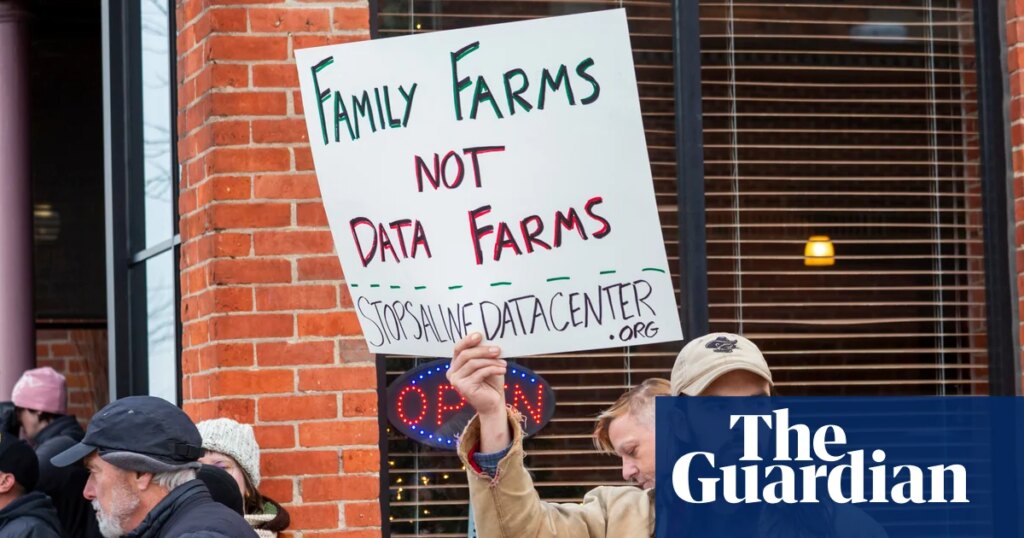
As tech giants scramble to create extensive datacenters to fuel artificial intelligence capabilities globally, offers like the one presented to Huddleston are becoming increasingly common on rural doorsteps across the United States. In fact, there are projections indicating that over the next five years, 40,000 acres of powered land—sites prepared for datacenter development—will be required, doubling the current figures.
Remarkably, despite the staggering offers that often far exceed the recent value of these lands, farmers like Huddleston are increasingly opting to remain steadfast. At least five of her neighboring landowners also declined similar lucrative offers, demonstrating a surprising sense of resolve.
In Pennsylvania, one farmer turned down a $15 million offer for his land, which he had farmed for five decades. In Wisconsin, another farmer rejected an $80 million offer, while other landowners have said no to bids exceeding $120,000 per acre—figures that were unimaginable just a short while ago.
These refusals serve as a profound reminder of the tangible limits of artificial intelligence and the disconnect between money and meaningful connections to the land.
The New Gold Rush
The Huddleston family has cultivated an enduring legacy shaped by their land for generations.
Ida’s grandfather, for instance, was growing tobacco during the Civil War. Her father cultivated wheat during World War I and navigated the remnants of the Great Depression. Ida, along with her five siblings, grew up harvesting beans, broccoli, and potatoes from soil once scorched by the dust bowl winds. Although none of the family members pursued higher education, by the age of ten, her children were already herding cattle across the same fields as their ancestors.
“My entire life revolves around this land. It has provided everything I needed for 82 years,” she shared from the cabin constructed by her late husband using regional materials decades earlier.
Where community members see serene streams and open spaces, tech executives view weak zoning regulations, inexpensive power, and plentiful water resources.
Developers are relentless in their pursuit, as there are vast fortunes to be made. Just last November in northern Virginia, an investor acquired less than 100 acres for a staggering $615 million; the property had been purchased by the seller for only $57 million just four years prior. Shortly after, Amazon spent $700 million on nearby farmland, which was sold for a mere fraction of that price the previous year. Additionally, a local developer in Georgia flipped a parcel to Amazon for $270 million after acquiring it for $4 million just a year earlier. For those in the middle navigating these transactions, potential returns can soar beyond 1,000%.
‘Name Your Price’
Approximately 20 residents from Mason County have reportedly received offers connected to the datacenter project, which is estimated to encompass 2,000 acres.
When Dr. Timothy Grosser, aged 75, turned down an $8 million offer for his 250-acre farm—3,500% more than what he had invested nearly 40 years earlier—the developers returned with a new offer: “Name your price.”
His response was clear: “There is none.”
Grosser lives, hunts, and raises cattle on his cherished land. His family tradition honors that land; each Christmas, they enjoy a turkey caught by his grandson on the property. Alongside Ida Huddleston, Grosser estimates that around four landowners have firmly rejected offers.
“All they’ve ever known is farming grain, cattle, and tobacco,” Grosser describes. “Like me, they feel that the money isn’t worth sacrificing their way of life.”
For Delsia Bare, 56, the connection to the family land runs even deeper than mere skill. She recalls spending summers hoeing weeds alongside her mother and grandmother, managing hay through the hot Kentucky months. “There’s an undeniable bond with the land. It’s unbreakable—it’s family history.”
Beyond their personal ties, farmers express concerns about broader repercussions. The decrease in the number of U.S. farms has surpassed 70% since 1935. Datacenters can overstrain power grids, deplete local water resources, contaminate the soil, and fragment wildlife habitats.
Bare puts it succinctly: “You won’t grow a loaf of bread from a datacenter.”
Not everyone is making the same choice; some farmers in Mason County are willing to sell if the datacenter project goes through. “You can’t fault them,” Grosser admits. “Ten million dollars for a farm is tempting.”
Despite this temptation, those who choose to refuse claim that the local utility company has hinted at the possibility of invoking eminent domain—an authority allowing the government to seize private property for public use. The concern is not unfounded; Dominion Energy exercised this power against a farmer in Virginia just last April.
‘Sometimes-Self-Sacrificial Stewardship’
The refusal to sell reflects a cultural aspect that economists often struggle to measure: the emotional and moral responsibilities tied to land stewardship. In his book *Love for the Land*, author Brooks Lamb elaborates on how family farmers’ “sometimes-self-sacrificial stewardship” can yield decisions that defy conventional financial wisdom, such as rejecting consolidation into larger industrial farming operations.
“When advised to ‘get big or get out’, these farmers often choose neither,” he writes.
For many, preserving their farm is seen as a “birthright,” according to Mary Hendrickson, a rural sociology professor at the University of Missouri. The obligation to uphold a legacy runs profoundly deep, occasionally leading to devastating consequences. During the 1980s’ farm crisis, for instance, over 900 male farmers in the Midwest took their own lives due to overwhelming debt and the threat of losing their land.
“These decisions are somewhat irreversible,” Hendrickson reflects. “If you allow the land to be transferred, it destroys its potential for agriculture.”
‘Keeping Our People Here’
Local officials in Mason County advocate that the datacenter would sustain future generations by generating essential tax revenue and job opportunities—an argument echoed in town halls across America.
Since 1980, Mason’s population has dwindled approximately 10%, primarily due to manufacturing losses. Proponents claim the datacenter project could yield 1,000 construction jobs, though it might only create around 50 permanent positions.
In areas like Loudoun County, Virginia—affectionately dubbed “Data Center Alley,” which manages around a fifth of the world’s internet traffic—tax revenue from datacenters nearly equals the county’s entire operating budget.
“We can either continue to shrink—losing population, jobs, and seeing our youth leave for better opportunities—or we can chart a new path,” stated Tyler McHugh, Mason County’s industrial development director, during a public hearing in December. “It’s about ensuring our people remain here.”
What Money Can’t Buy
While developers offer multi-million-dollar deals, they aren’t exactly stealing Mason County’s land; however, many farmers feel an intangible sense of loss nonetheless.
Just months before the unexpected visit last May, Delsia Bare faced a significant setback—she lost most of her vision. Now, she leans on sensory experiences to stay connected with the land: the melody of birds, the flow of the creek. She fears the intrusive noise of a datacenter may disrupt those connections, transforming the farm from a living environment into a memory.
For now, Bare holds firmly to her family’s legacy, echoing her mother’s words: “The land, the land, the land.”
In an era where AI promises to transcend physical limitations, these conflicts underscore the tangible constraints of technology—and Wall Street’s miscalculations regarding what truly matters to people. In the rolling hills of Mason County and across the agricultural expanse of America, that gap isn’t measured in dollars, but in something much harder to quantify: identity.
Interested in growing your brand with smarter solutions? Get in touch with Auctera today.

Jessica
https://www.linkedin.com/company/aucteraAffiliate Content Writer