Opposition to the Machine: A California Community United Against a Data Center – and Triumphed
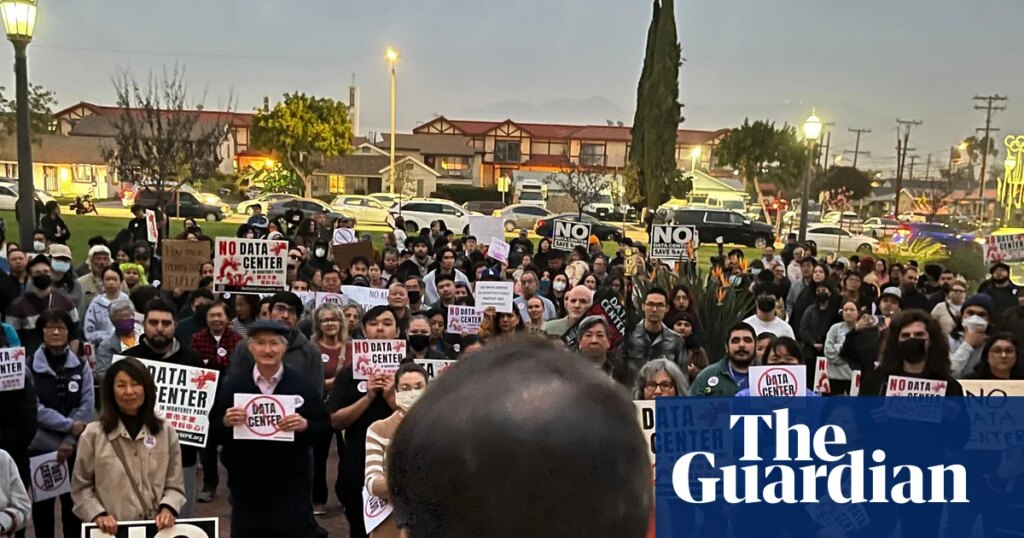
In December, a proposal from a southern California city council to construct a massive datacenter spanning the equivalent of four football fields sparked significant concern among five committed residents determined to halt the project.
This small group leveraged a rapid word-of-mouth campaign to raise awareness about the datacenter planned for Monterey Park, a quaint city located east of Los Angeles, often dubbed as the country’s first suburban Chinatown.
The organizers from No Data Center Monterey Park, collaborating with the grassroots racial justice group San Gabriel Valley (SGV) Progressive Action, conducted a teach-in session and rally that attracted hundreds of participants. They engaged in grassroots efforts, knocking on doors and distributing informative flyers in busy public areas.
The group highlighted the negative impacts of the proposed facility, arguing that it would overextend the power grid, escalate energy costs, and contribute to noise pollution. Their efforts bore fruit as a petition rapidly gathered nearly 5,000 signatures. All campaign materials were made available in English, Chinese, and Spanish—a thoughtful strategy aimed at Monterey Park’s diverse community, which comprises approximately two-thirds Asian and one-quarter Hispanic residents.
Remarkably, within just six weeks, the community achieved a significant victory. City officials announced a 45-day halt on datacenter construction, accompanied by a commitment to explore the possibility of a permanent ban.
“It feels like the climax of an Oscar-nominated film,” remarked Steven Kung, a co-founder of No Data Center Monterey Park.
In the preceding year, grassroots movements against datacenters have emerged across a divided nation, animating local board meetings from urban centers to agricultural communities. Data recorded by the group Data Center Watch indicates that local entities delayed or cancelled $98 billion worth of projects between late March and June of 2025. This data reveals that over 50 active groups across 17 states successfully targeted 30 specific projects during this timeframe, with two-thirds of those being halted.
Monterey Park residents gathered at city hall on 21 January to speak out against the construction of a datacenter. Photograph: Steven Kung
The growing resistance to these facilities has formed unlikely alliances, uniting groups with differing ideologies, from “NIMBYs” to environmentalists in Virginia, and even “Stop the Steal” activists alongside Democratic Socialists of America affiliates in Michigan.
“There’s no safe space for datacenters,” asserted Miquel Vila, a lead analyst at Data Center Watch, a research initiative operated by AI security firm 10a Labs. “Opposition to these projects is bubbling up in diverse communities nationwide.”
Widespread Discontent Across Party Lines
Datacenters have proliferated in states abundant with land, low energy costs, and attractive tax incentives. While these facilities support various services, including streaming and artificial intelligence, the public sentiment towards them is largely negative due to their significant consumption of resources. An November Morning Consult poll illustrated that most voters favor a ban on datacenter construction in their vicinity, attributing part of the increasing electricity costs to “AI datacenters.”
According to Vila, increased media coverage from national outlets—especially regarding protests and discontent in the northeast and midwest—has played a crucial role in consolidating local struggles into a more united front. The growing attention to datacenters “has sparked a nationwide dialogue, reinforcing local sentiments,” Vila remarked.
In Indiana, recognized as a significant datacenter hub with over 70 facilities, communities have initiated opposition against an additional 50 projects, halting at least a dozen within the past year. This data originates from the Citizens Action Coalition, an advocacy group focused on consumer and environmental causes based in Indianapolis.
“It’s a grassroots uprising in the heartland,” emphasized Bryce Gustafson, an organizer for the Citizens Action Coalition. “The resistance spans bipartisan lines, displaying a remarkable unity against these datacenters.”
The protest against datacenters, especially within the traditionally Republican state of Indiana, has been fueled by a backlash against solar energy projects on agricultural land that many locals believe compromise the rural landscape. Concerns over land ownership and technological dominance have unified conservatives and environmental activists, generating town hall meetings, canvassing efforts, and even legal actions against the proposed projects.
“For many residents, datacenters symbolize a deeper mistrust towards big tech and the political system that enables their expansion,” stated Gustafson.
As local movements against AI infrastructure continue to gain momentum, they are influencing discussions at both state and federal levels, especially as midterm elections loom. In Virginia, where over 600 datacenters exist, recently elected governor Abigail Spanberger pledged to advocate for lower utility costs by ensuring that AI corporations pay their fair share for electricity rather than shifting the burden to residents. Prominent progressive lawmakers like Bernie Sanders and Rashida Tlaib have voiced support for moratoriums on datacenters, while GOP leaders, including Florida’s Ron DeSantis and Missouri senator Josh Hawley, have proposed legislation to regulate the sector.
Community-Driven Decision Making
In Monterey Park, the primary concerns surrounding the proposed datacenter are its economic, environmental, and public health ramifications. The facility is set to use 14 diesel generators, which are known to produce “ambient air pollutants,” such as nitrogen oxides—substances linked to severe respiratory ailments like asthma and lung cancer.
Hrag Balian, an organizer, articulated that the No in Data Center Monterey Park group drew inspiration from other activist movements in areas such as Virginia and Pennsylvania. “We entered this struggle without prior experience, so observing the strategies and lessons learned in other places has been invaluable,” he stated.
Kung emphasized that a foundational strategy of their organizational approach involved forming alliances with various community entities in the greater San Gabriel Valley, including SGV Progressive Action, the Asian Youth Center, and the Montebello Teachers Association. Each group mobilized their members to participate in public testimonies during the January city council meeting. “It’s a decentralized movement,” he highlighted.
Andrew Yip, a community organizer affiliated with SGV Progressive Action, noted that the campaign’s success was attributed to residents uniting around a common goal: preventing a development detrimental to their livelihoods. “This is about community members stepping up to protect one another,” Yip described.
For the activists in Monterey Park, their efforts are far from over. Instead of outright rejecting the proposed facility, city council members are deliberating the possibility of placing this decision before voters in the upcoming November ballot. Kung expressed that this would necessitate a “lengthy awareness campaign” on datacenters leading up to the election. Meanwhile, the organizers plan to continue engaging new residents, collecting petition signatures, and participating in council meetings.
“We’ve achieved a victory, but there’s still an extensive amount of work ahead,” concluded Kung.
Interested in growing your brand with smarter solutions? Get in touch with Auctera today.

Jessica
https://www.linkedin.com/company/aucteraAffiliate Content Writer