A Tribute to a Director: Darren Aronofsky’s AI Revolutionary War Series Takes on Horror Elements
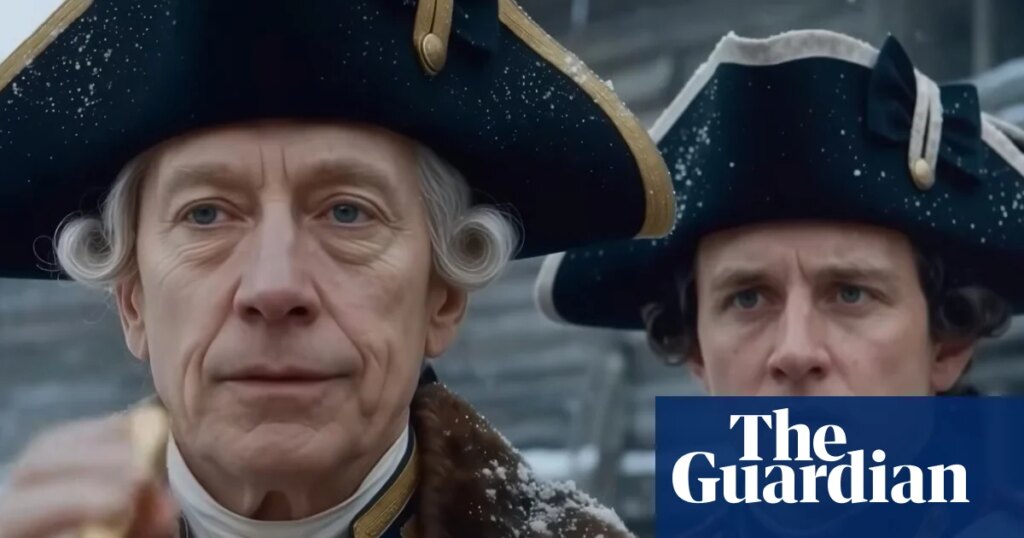
If you ever find yourself wandering through Time magazine’s YouTube account—perhaps because you’re a time traveler from the 1970s struggling to grasp our modern world—you may stumble upon a series that many consider to be at the forefront of contemporary entertainment.
The series titled On This Day… 1776 offers a collection of brief videos showcasing America’s Revolutionary War. What stands out about On This Day is not only that it was crafted by Darren Aronofsky’s studio, Primordial Soup, but that it also employs AI technology in its production. Unfortunately, amidst these intriguing elements lies a harsh truth: the series is remarkably subpar.
The inaugural episode, which runs for approximately three and a half minutes, features George Washington raising a new flag over Prospect Hill, defiantly challenging King George III. The video description claims this moment signifies that “rebellion becomes resolve.” However, if that phrasing makes you uneasy, brace yourself for the viewing experience.
Visually, the series is incredibly unsettling. It appears to strive for photorealism but ultimately fails spectacularly. In the very first image, King George’s hair resembles a contrived blend of melted plastic and a badger. This is frustrating because much of the animation relies on shots where characters are viewed from behind. This choice likely stems from the fact that an AI-generated back is less likely to trigger nightmares than a facial depiction, which also aligns with Aronofsky’s penchant for humanist storytelling.
And let’s talk about those faces. Given that the Revolutionary War was predominantly initiated by older men, the series is flooded with the wrinkled, almost uncanny visages of several historical figures. It’s disconcertingly eerie to witness these characters, who sport the vacant eyes typically associated with stop-motion animation, especially when their wrinkles seem to continually shift in color and depth.
This effect creates the appearance of characters drawn on multiple layers of tissue paper that were never properly aligned. Benjamin Franklin, who appears in the second episode, is particularly disturbing; he bears an unsettling resemblance to a genetic merger of Hugh Laurie and Anthony Hopkins, complete with a sprinkling of unruly liver spots. Though it may sound exaggerated, watching it truly evokes a sense of discomfort.
Interestingly, On This Day has attracted attention for what some see as a shortcut: all voices in the series are performed by human actors. This decision seems to reveal the stark reality that, while the technology is evolving, the creators still rely on human talent to lend credibility to the project. The voiceovers are, in fact, the most convincing aspect of the series—especially when utilized without visual distractions, allowing the audience to focus solely on the narrative and not the disjointed lip movements.
However, as unsettling as it may be, the day is fast approaching where such human involvement may no longer be necessary. Although On This Day is undeniably flawed, it presents a considerable leap forward compared to other AI-generated content. It may still resemble a bizarre blend of an animatronic convention and outdated Taiwanese news cartoons, but it showcases a marked improvement over previous attempts. There’s a genuine sense that we’re moving toward a future where entirely lifelike AI creations, complete with immersive human voices, will become a reality. When that moment arrives, Aronofsky may find himself witnessing the fruits of his labor automating his own profession.
It will be fascinating to observe how the human film community responds to On This Day, particularly in regard to actors. The series appears to model its characters after recognizable human faces, with Thomas Paine notably reflecting traits from several famous actors such as Ralph Fiennes, Daniel Day-Lewis, and Matthew Macfadyen.
Less than two years ago, Scarlett Johansson enlisted legal help upon discovering that an OpenAI application emitted a voice strikingly similar to hers. Given this context, it isn’t far-fetched to anticipate that actors might seek legal protections if they recognize their likenesses in AI-generated portrayals.
However, that is a conundrum for another time. What’s paramount now is that On This Day… 1776 is genuinely unsettling, and all those involved ought to reflect on the shoddy execution. This might easily be the most alarming project Aronofsky has been a part of, and considering I’ve witnessed the last eight minutes of Requiem for a Dream, that’s no small feat.
Interested in growing your brand with smarter solutions? Get in touch with Auctera today.

Jessica
https://www.linkedin.com/company/aucteraAffiliate Content Writer